
Top 10 Facts About Velociraptors
Velociraptors, often referred to as just “raptors”, have quite a reputation. The creatures have been one of the main sources of fear for many Jurassic Park fans over the last three decades, but how accurate was that villainous portrayal?
The mythbusting answers around the creature’s size, habits, and more may surprise you.
At Fossils UK, we love all things dinosaurs, and we’re always keen to share our knowledge. If you’re looking to learn more about one of the world’s most famous prehistoric animals, you’re in the right place! We’re excited to share some of the best facts about velociraptors and even have a fun quiz lined up to test your new knowledge!
- Velociraptors were much smaller than you’d think
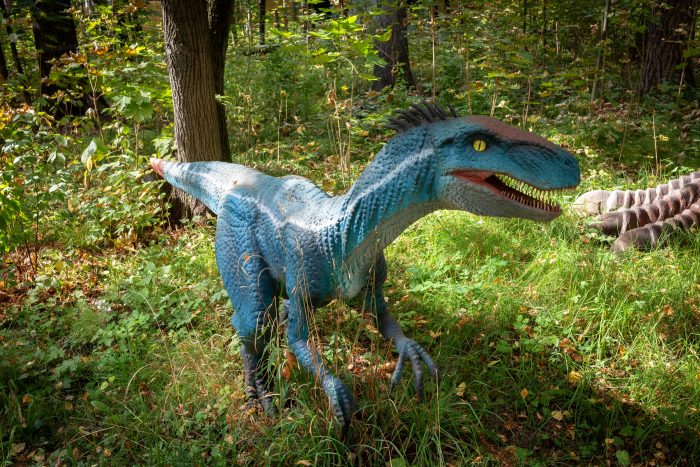
In popular media like the Jurassic films, velociraptors are shown as tall, menacing creatures that stalk the main characters and provide a real threat to their safety. In reality, these dinosaurs were nowhere near their on-screen size. Most velociraptors were the size of turkeys or large chickens. On average, a velociraptor would’ve only been around 2 metres long (tail included), and half a metre tall.
- Velociraptors had feathers, not scales
When thinking of velociraptors, many people picture large lizard-like creatures that share many physical characteristics with modern reptiles. Well, we’ve already busted the size myth; now we’re about to disprove the reptile theory. Velociraptors actually had feathers rather than scales. Evidence has shown that, much like many modern birds, velociraptors had quill knobs on their bones. While they didn’t fly, feathers may have helped raptors with balance and attracting mates.
- Did Velociraptors really have sharp claws?
If you’ve seen the Jurassic films, you’re probably wondering if any of what you were shown was accurate after those first two facts. Luckily, the raptors’ claws, which they use to great effect in the movie, allow us to celebrate a realistic depiction. While they may not have been used as aggressively as in the films, velociraptors did have sharp claws that mostly served as hooks to prevent prey from escaping.
- Were Velociraptors fast?
Another win for the films! They may not have chased prey at lightning speeds with substantial size to back it up. However, research suggests that velociraptors certainly weren’t slow when pursuing prey or escaping larger predators. Their long legs and physiology allowed them to reach up to 25mph. Not blistering, but certainly quick enough to survive and thrive.
- What did Velociraptors eat?
A carnivorous dinosaur, the velociraptor would hunt and scavenge for other animals to sustain itself during the late Cretaceous period. You can learn more about this period in our full guide to the Mesozoic Era. Velociraptors likely fed on smaller animals like reptiles, amphibians, insects, mammals, and small dinosaurs.
- Where did the name Velociraptor come from?
The origin of the velociraptor’s name is possibly the most beloved etymology (the history of language) of any prehistoric creature. It’s derived from the Latin words “velox”, meaning swift, and “raptor”, translating to robber. Therefore, making the velociraptor the swift robber. An apt title that accurately describes the nature of the dinosaur as it scurried and swiped food wherever it could find it. The name is credited to Henry Fairfield Osborn, who coined it in 1924.
- Where did Velociraptors live?
Since the release of the first Jurassic Park film in 1993, there has been a perception that raptors were discovered and lived in America. In fact, velociraptors were native to Mongolia approximately 70 million years ago. The East Asian country would have been a desert in the late Cretaceous, ideal conditions for velociraptors to thrive.
- Were Velociraptors very smart?
One of the most iconic scenes from the film is when a velociraptor shows its intelligence by figuring out how to turn a doorknob. While real raptors weren’t that smart, they certainly had a prehistoric version of street smarts. Its brain was relatively large compared to the rest of its body, suggesting a decent level of intelligence.
- Did Velociraptors hunt in packs?
Raptors are commonly depicted as highly coordinated and collaborative animals. Teaming up to tackle potential prey and secure a meal for the whole group. However, there is very little evidence to suggest this is the case. The idea comes from the discovery of fossilised bones of a similar species around a single, smaller dinosaur. The exact hunting method of velociraptors remains a topic of debate for experts.
- Jurassic Park’s big Velociraptor secret
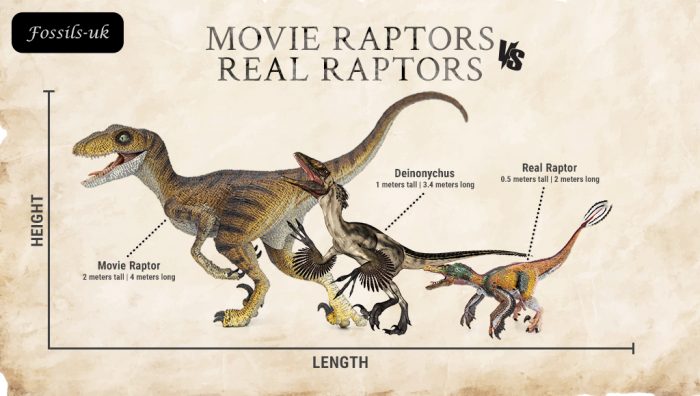
Okay, this is the big one. Remember that “similar species” we mentioned in the last section? That was deinonychus, a meat-eating dinosaur taller than a velociraptor but with plenty of similar traits. These were the animals the creators of Jurassic Park/World used as inspiration for the velociraptors. They borrowed the name, but everything else about the creatures we saw on screen lined up much more accurately with their larger siblings. We’re very sorry if this breaks the movie magic!
QUIZ: Test your Velociraptor knowledge
Take our quiz and show off your brand new raptor knowledge!
1. What does the word “velociraptor” mean?
2. How tall were velociraptors?
3. What modern country did velociraptors live in?
4. Which of the following is true?
5. Which dinosaurs are the raptors from the Jurassic films actually based on?
Browse our range of dinosaur fossils at Fossils UK
Wow! You really know your stuff. It’s great to have another velociraptor expert join the team. Want to learn more about other dinosaurs? There’s no better place to look than our dinosaur fossil collection at Fossils UK.
Fossils allow us to study creatures from millions of years before we were born and learn how they lived, where they roamed, and what they ate. It’s a fascinating look into a world before our time, and our collection is a perfect window into it!
Browse our collection today and visit our blog for more interesting articles!
Comments are closed here.