
Top 10 Facts About the T. Rex
When you think of dinosaurs, the image of a ginormous creature with small arms, a long swinging tail, and a distinctive reptile-like frame is sure to come to mind. The Tyrannosaurus Rex is inarguably the most well-known and popular dinosaur species, helped in no small part by their portrayal in various fictional works over the years.
At Fossils UK, we celebrate all things prehistoric and want to pass down our knowledge and expertise to budding dinosaur enthusiasts looking to learn more about some of the most fascinating creatures to ever roam the earth.
Read on to separate fact from fiction and learn the most important and interesting facts about the Tyrannosaurus Rex.
- How big was the T. Rex?

Perhaps the animal most synonymous with the term “large dinosaurs”, the T. rex wasn’t actually the biggest of them all, but it certainly wasn’t far off. The iconic giant measured 12 metres in length and could grow to 4 metres tall. It’s estimated that a T. rex could weigh up to 12.7 tonnes, similar to an elephant. Learn more about the largest dinosaurs to ever live in our detailed blog post.
- Did the T. Rex have feathers?
While it’s difficult to say for certain, it does seem like a strong possibility that T. rex would’ve sported feathers. T. rex are clarified as a theropod, and researchers have found evidence of feathers on many other dinosaurs of the same type. This opens the possibility of a feathered T. rex. In all likelihood, a T. rex would’ve had thin feathers during its early years as a source of heat before shedding them as it grew larger into adulthood and generated much greater body heat.
- Could the T. Rex swim?
Several works of fiction under the Jurassic branding have depicted a T. rex delving into the water in pursuit of humans. While the T. rex’s ability to swim may not have been quite as strong as suggested by the book and subsequent films, there is some truth to the T. rex’s aquatic capabilities. Tyrannosaur footprints indicate the creatures could certainly enter the water, and swimming evidence from their relatives suggests that a T. rex would be capable of basic swimming.
- How many teeth did T. Rex have?
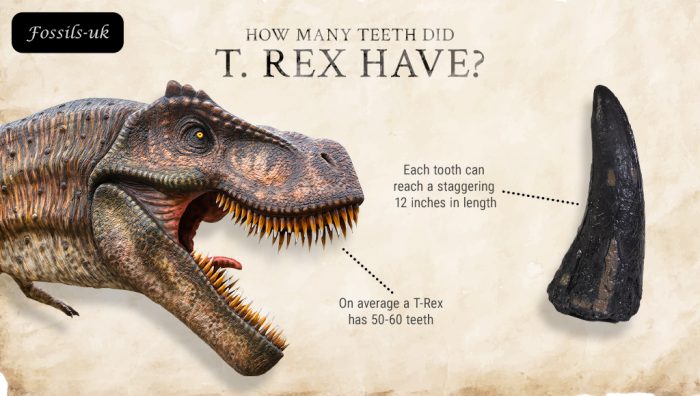
A T. rex would have a mouth full of, on average, 50-60 teeth that were capable of tearing through nearly 100kg of flesh in just one bite. These were no mere molars either; each tooth could reach a staggering 12 inches in length. T. rex would often shed and regrow teeth, with research indicating that they could be replaced roughly once every 250 days.
- When & where did T. Rex live?
Tyrannosaur was a very late entry to the prehistoric ecosystem, living during the Late Cretaceous period. The earliest evidence of a T. rex dates to approximately 90 million years ago, and the species persisted for about 34 million years before extinction. The majority of T. rex fossils have been discovered in North America, mainly to the west of the continent. Learn more about the times in which tyrannosaurs roamed the planet in our guide to the Mesozoic Era.
- What did T. Rex eat?
Due to its size and powerful teeth, the T. rex was an apex predator that hunted other animals for food. Edmontosaurus, a duck-billed dinosaur, is believed to have been among the creatures preyed upon by T. rex. Bite marks have also been identified on Triceratops fossils, suggesting that they, too, were targeted by the predators. Eating large dinosaurs wouldn’t have been a problem for tyrannosaurs, as a joint in their jaw allowed for swallowing large chunks at a time.
- Did the T. Rex really roar?
One of the most iconic sounds in film history is the first time you hear the mighty roar of the T. rex in Jurassic Park. The incredible screech wowed cinema goers in 1993 and remains one of the most famous moments from any film of the era. However, this was all a bit of Hollywood magic. No fossilised evidence suggests that tyrannosaurs had the sound-producing organs required to make such a scary noise. A T. rex would likely have uttered a deep murmur from the throat, similar to crocodiles.
- When was the T. Rex discovered?
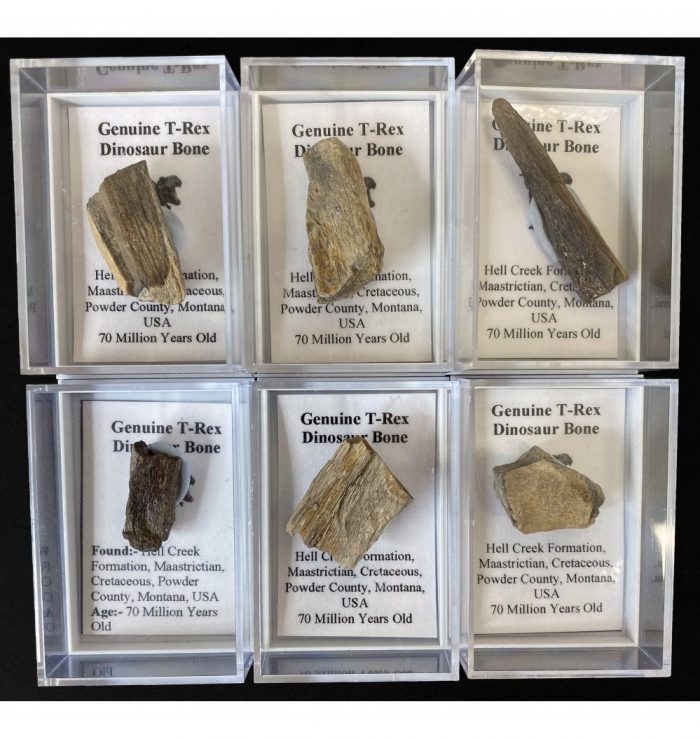
The first partial skeleton of the iconic T. rex was discovered by paleontologist Branum Brown in the US state of Wyoming in 1900. Two years later, Barnum discovered another partial skeleton in nearby Montana composed of 34 fossilised bones. At Fossils UK, we stock a genuine T. rex bone from the Hell Creek Formation, the same location where Barnum made his monumental discoveries. Learn more about this discovery and more in our post covering the earliest dinosaur discoveries.
- Where does the name “T. Rex” come from?
In 1905, three years after the second partial skeleton was discovered, T. rex was named by Henry Fairfield Osborn. The president of the American Museum of Natural History chose the name Tyrannosaurus based on the Greek words meaning “tyrant lizard”. The addition of rex, the Latin word for “king”, was added to emphasise the size and dominance of the creature. Therefore, the full translated name reads “King Tyrant Lizard”.
- What killed the T. Rex?
The T. rex went extinct in the same fashion as every other creature at the end of the Late Cretaceous. An asteroid that would have left a 150 km-wide crater struck the Earth and vaporised upon impact. This mass extinction event, caused by the asteroid’s impact on the planet’s environment, eliminated all non-avian dinosaurs, marking the end of an approximately 192-million-year era.
Quiz: Put your knowledge to the test!
Let’s see how much T. rex knowledge you’ve got under your belt. Take our quiz and see your T. rex trivia in action!
1. How often could T. rex replace their teeth?
2. What languages were used to create the name “T. rex”?
3. What period did the T. rex live during?
4. On which modern continent did the T. rex likely live?
5. Which dinosaur’s fossils contain bite marks that suggest they were prey for the T. rex?
Discover T. Rex fossils at Fossils UK
Now that you’re a certified Tyrannosaurus expert, you can celebrate your status with our collection of incredible and authentic T. rex fossils at Fossils UK.
Whether you’re a collector at the beginning of your journey, looking for the perfect first piece, or you’re shopping for a dino-obsessed loved one of any age, our collection presents several fascinating items from a bygone era that can be proudly displayed and examined. Browse our complete dinosaur fossils collection today for more.
Comments are closed here.