
American vs Moroccan Dinosaur Teeth: A Collector’s Guide
For passionate palaeontology enthusiasts, adding a genuine dinosaur tooth to your collection is a thrilling milestone. These prehistoric relics offer a tangible connection to the magnificent creatures that once roamed our planet millions of years ago. Among the most sought-after specimens on the market are those sourced from the United States and Morocco. Both nations boast incredibly rich fossil records, yet they present entirely different collecting experiences.
This guide from Fossils UK compares fossils from these two iconic regions. We will explore why American and Moroccan dinosaur teeth hold such great value and examine the distinct species associated with each area. Unfortunately, the fossil market also includes fabricated specimens. We will provide detailed guidance on how to avoid fake dinosaur-teeth listings, ensuring your investments remain authentic and scientifically valuable.
Table of contents
- The geological history of America and Morocco
- Dinosaur species discovered in the USA vs Morocco
- Where dinosaur teeth are found in America
- Why the Kem Kem Beds are a Moroccan fossil hotspot
- Collect high-quality American and Moroccan fossils at Fossils UK
The geological history of America and Morocco
To understand why America and Morocco are premier destinations for fossil discovery, we must look at their geological history. Preserving dinosaur remains requires very specific environmental conditions. After death, an animal must be buried rapidly under sediment to protect it from scavengers and the elements.
Throughout the Mesozoic Era, which you can learn more about in our Mesozoic Era guide, vast swathes of North America featured floodplains, sprawling river systems and shallow inland seas. These aquatic environments were perfect for depositing thick layers of sand and mud over dinosaur remains. Over millions of years, these sediments hardened into rock, preserving teeth and bones. The shifting tectonic plates later pushed these deep rock layers to the surface. Modern erosion across the arid American West now exposes these ancient treasures to palaeontologists.
Morocco shares a similarly perfect storm of geographical luck. During the Cretaceous period, an enormous river system covered parts of North Africa. This lush delta was home to giant predatory dinosaurs and massive aquatic life. When these creatures died, they sank into the riverbed and were swiftly entombed in the silt. Today, the Sahara Desert covers this once-tropical paradise. The dry, stark conditions of the modern Moroccan landscape make excavating these exposed fossil beds highly productive. You can trace the climatic shifts that made such preservation possible by reading our overviews of the Paleozoic and Cenozoic eras.
Dinosaur species discovered in the USA vs Morocco
The geographical distance and differing environments between Mesozoic North America and North Africa mean that collectors will find completely different dinosaur profiles in each region. American deposits are famous for Late Cretaceous heavyweights and iconic Jurassic herbivores. Moroccan sites are renowned for producing an unusually high concentration of large theropods.
When buying these specimens, collectors must be vigilant. Unscrupulous sellers often piece together fragments of different teeth to create one large, impressive-looking piece. Always look for continuous enamel patterns and natural wear. A sudden change in colour or texture midway down a tooth often indicates a composite fake.
Below is a comparison demonstrating the prominent species discovered in each nation and their specific regions.
| Dinosaur Species | Country of Origin | Prominent Discovery Location |
| Tyrannosaurus Rex | USA | Hell Creek Formation |
| Allosaurus | USA | Morrison Formation |
| Triceratops | USA | Hell Creek Formation |
| Spinosaurs | Morocco | Kem Kem Beds |
| Carcharodontosaurus | Morocco | Kem Kem Beds |
| Deltadromeus | Morocco | Kem Kem Beds |
Where dinosaur teeth are found in America
The United States features several legendary geological formations that have shaped modern palaeontology. Each region offers distinct specimens with unique historical and monetary value for collectors.
The Hell Creek Formation
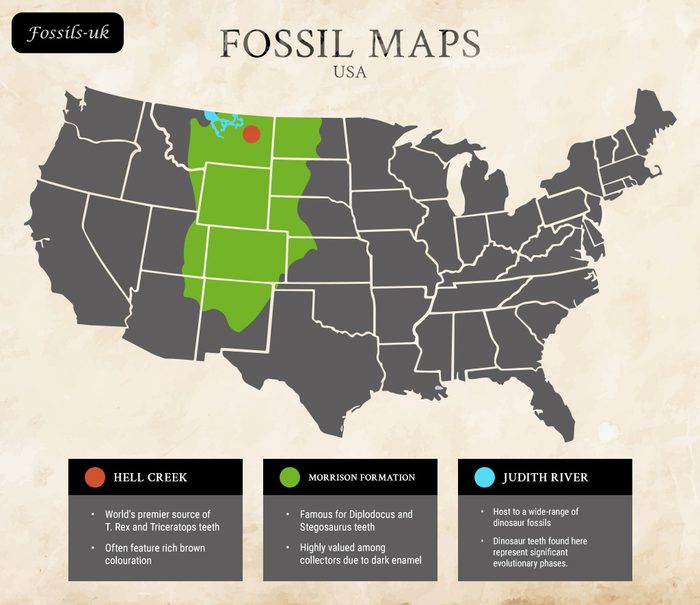
Spanning Montana, North Dakota, South Dakota, and Wyoming, Hell Creek is arguably the world’s most famous fossil site. This Late Cretaceous deposit is the premier source for Tyrannosaurus rex and Triceratops teeth. Fossils found here are highly prized because of the massive cultural popularity of these dinosaurs. Authentic Hell Creek teeth often feature rich brown and black colouration from surrounding minerals. To spot a fake Hell Creek tooth, closely examine the serrations. Forgers sometimes carve fake serrations into bone fragments to mimic a T. rex tooth, but these artificial grooves usually lack the uniform, precise spacing seen in nature.
The Morrison Formation
If you are hunting for Jurassic-era treasures, the Morrison Formation is the definitive source. Stretching across several western states, including Colorado and Utah, this region is famous for apex predators like Allosaurus alongside giants like Diplodocus and Stegosaurus. Allosaurus teeth are typically smaller and more blade-like than T. rex teeth. Collectors highly value Morrison Formation teeth for their dark, lustrous enamel. Be wary of specimens that look artificially shiny. Some sellers coat heavily repaired teeth in thick varnish to hide plaster crack fills. A genuine fossil should have a natural, stony texture.
The Judith River Formation
Located primarily in Montana, the Judith River Formation is slightly older than Hell Creek. It yields incredible fossils from a diverse ecosystem of horned dinosaurs, duck-billed dinosaurs and tyrannosaurids like Daspletosaurus. Teeth from this region are historically significant because they represent a crucial transitional phase in North American dinosaur evolution. Collectors value Judith River specimens for their varied preservation colours, which range from light caramel to deep mahogany. When purchasing from this region, use a magnifying glass to check for unnatural paint lines. Scammers sometimes paint over plaster restorations to match the natural fossil colour.
Why the Kem Kem Beds are a Moroccan fossil hotspot
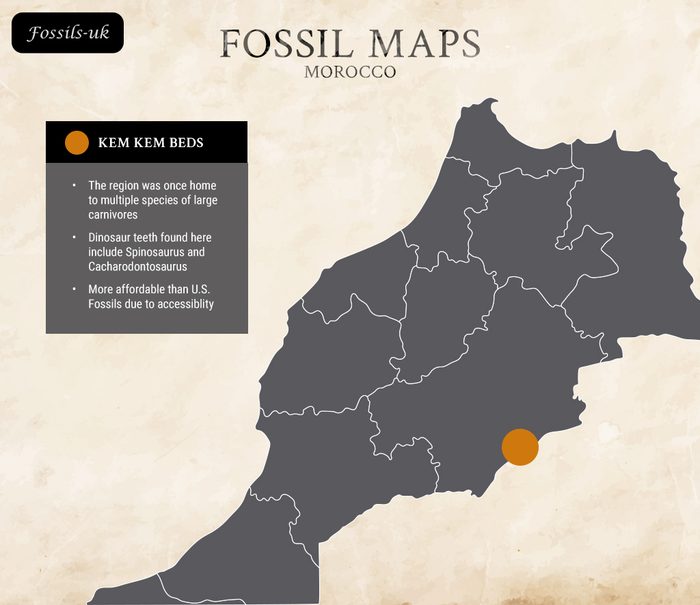
The Kem Kem Beds are a geological group located along the border of Morocco and Algeria, recognised as one of the most important palaeontological sites on Earth. This area is a renowned fossil hotspot for several key reasons:
- Ideal Ancient Environment: During the mid-Cretaceous period, this region was a vast, sprawling river delta. This lush aquatic ecosystem was well suited to rapidly burying and preserving animal remains in thick river silt.
- Unprecedented Predator Density: Palaeontologists often call it “the most dangerous place in the history of planet Earth” because the ecosystem supported multiple massive carnivores at once, resulting in a staggering volume of predator fossils.
- Iconic Dinosaur Species: The beds regularly yield remarkable specimens, including the conical, unserrated teeth of the massive river-dwelling Spinosaurus and the serrated, shark-like teeth of the apex predator Carcharodontosaurus.
- High Fossil Accessibility: Because teeth are incredibly common in these deposits, they are generally more affordable than American fossils. This abundance makes Kem Kem Bed specimens fantastic entry-level pieces for new collectors.
However, this high volume also brings a high risk of fakes. Moroccan diggers occasionally fabricate tooth roots to increase a specimen’s value. They mix crushed rock, sand and glue, attaching this mixture to the base of a genuine shed tooth to make it appear complete. Always check the boundary where the smooth enamel meets the root. If the transition looks clumsy or feels suspiciously gritty and uniform, the root is likely manufactured.
Collect high-quality American and Moroccan fossils at Fossils UK
Building a dinosaur tooth collection is a deeply rewarding journey that connects you directly to the ancient world. Curating your own museum lets you hold millions of years of history in your hands. Whether you seek the legendary Tyrannosaurus rex teeth of the American West or the fascinating Spinosaurus relics from the Moroccan Sahara, each specimen adds a unique chapter to your prehistoric display.
As your showcase grows, you will begin to appreciate the distinct evolutionary traits that these diverse fossils reveal. Fossils UK supports your passion for palaeontology. We offer an extraordinary range of carefully sourced American and Moroccan dinosaur teeth to suit both novice enthusiasts and seasoned curators.
Comments are closed here.