
The Life & Death of Trilobites – Our Prehistoric Guide
Over 250 million years after their extinction, trilobites remain one of the most fascinating creatures to have ever lived on planet Earth. Their ability to adapt and survive outweighs many of their contemporaries in periods spanning from the Cambrian right up to the end of the Permian.
Trilobites defined the Paleozoic Era, and at Fossils UK, we are eager to share our knowledge and expertise on the life, times, and eventual death of one of history’s most resilient animals.
Read on to learn all about the anatomy, survival techniques, extinction and human discovery of trilobites in our comprehensive guide that tells you everything you need to know about the group that ruled the oceans.

TL;DR
Trilobites were an immensely successful group of marine arthropods that survived for nearly 300 million years during the Paleozoic Era, primarily due to their diverse diets, adaptable anatomy and reproductive strategies. They ultimately became extinct during the Permian mass extinction, but landmark fossil discoveries continue to reveal incredible details about their biology, from their calcite eyes to their soft tissue anatomy.
Table of contents
- What was a trilobite?
- How trilobites lived for so long
- When did the trilobites go extinct?
- A history of trilobite fossil discoveries
- Browse incredible trilobite fossils at Fossils UK
What was a trilobite?
Trilobites were a group of marine arthropods that lived throughout nearly the entire Paleozoic Era. They appeared midway through the Era’s first period, the Cambrian, and survived in many forms until the Permian came to a close.
An exceptionally diverse group, over 22,000 species of trilobite have been described since they were added to the fossil record. They are truly a sight to behold, but perhaps not for those with entomophobia or a fear of arachnids, as they somewhat resemble a cross between modern marine insects and certain spiders.
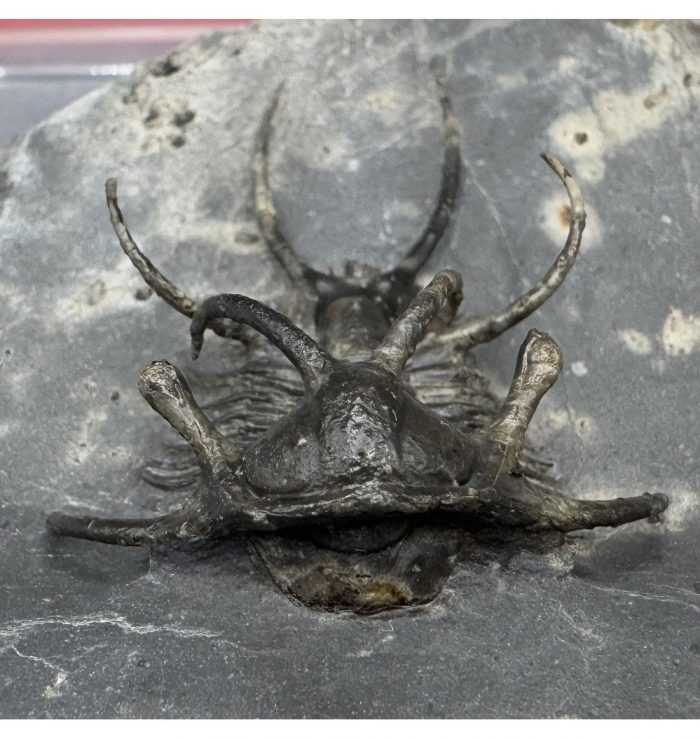
The name trilobite means “three-lobed entity”. Most trilobites were characterised by their distinctive three-fold appearance, which featured an easily identifiable head, midsection, and lower body. Below, we provide a more detailed examination of the anatomy of the common trilobite.
Trilobite anatomy
Crucially, the body was also split vertically into three major tagmata (sections) running from head to tail. This remarkable segmented design allowed for the incredible diversity and durability seen throughout their near 300 million-year reign.

Here are the three defining sections of the trilobite body:
The Pygidium (Tail Section): Situated at the posterior end, the pygidium was a solid shield formed from its own set of fused segments. Its primary function was to protect the rear-most organs and likely provided essential stabilisation or even propulsion, depending on the species’ preferred method of movement through the water column.
The Cephalon (Head Shield): This is the anterior region of the body, formed from a series of segments that are tightly fused. It served as the command centre, typically housing large, complex compound eyes that offered a vast, panoramic field of vision, along with the antennae and the mouth. Beneath the surface was the hypostome, a calcified plate that covered the oesophagus and mouth, vital for both feeding and protecting the delicate feeding apparatus.
The Thorax (Midsection): Located directly behind the cephalon, the thorax was made up of several flexible, articulating segments. This ingenious design granted the trilobite significant mobility, allowing it to crawl across the seabed or, when threatened, roll itself into a tight, protective ball, much like a modern woodlouse or pill bug. This defensive posture effectively shielded the vulnerable soft underside of the creature.
How big were trilobites?
Trilobites varied remarkably in size, though the vast majority measured between 3 and 10 centimetres in length. This modest average size was a significant advantage, allowing them to seamlessly occupy diverse marine niches, hide efficiently from larger predators, and sustain themselves on minimal food sources. However, their dimensions were far from uniform. Some microscopic species were no larger than a single millimetre and floated effortlessly amongst the plankton.
Conversely, certain apex predators, such as the formidable Isotelus rex, grew to over seventy centimetres long! By adapting their physical proportions to suit entirely different environments, these fascinating arthropods ensured their widespread dominance across ancient oceans.
How trilobites lived for so long
To put it simply, trilobites were incredible survivors. Some trilobites burrowed in sediment, and others found the sea floor a more suitable habitat. Several trilobites even swam in open water in search of food.
Their varied diet is one of the reasons why the group lived for such an extraordinary length of time. Plankton, crustaceans, detritus, bivalves, and self-producing bacteria all played a part in fueling one of the longest-lasting groups to have ever lived.


Learn more about trilobites’ eating habits in our complete dietary guide.
Other key factors that contributed to their survival include:
Adaptability
- Diverse habitats: Trilobites were able to live in a wide range of ocean environments. Whether it was shallow coastal waters or the deep sea, trilobites found a home.
- Varied diets: Fluidity in the food chain between species was key for trilobites. They could survive as predators, scavengers or filter feeders.
- Roles: The sheer diversity of trilobite species allowed them to fill whatever ecological role was necessary as the marine environment evolved.
Defensive capabilities
- Rigid exoskeleton: The solid outer skeleton helped protect against predators as well as general physical harm.
- Posture: Many trilobites could roll into a tight ball to protect themselves and shield their soft undersides.
- Unique features: Some trilobite species evolved to develop specialised features such as interlocking segments and complex eyes to defend themselves.
Reproductive advantages
- High output: After mating, female trilobites would lay a large number of eggs. This volume increased the group’s survival chances even after extinction events.
- Wide distribution: Even if one type of trilobite were wiped out, there would be thousands of others scattered around the world.
- Rapid adaptation: Generations of trilobites came and went relatively quickly, enabling them to adapt to changing conditions quickly.
When did the trilobites go extinct?
Despite surviving ever-changing climate conditions over a scarcely believable span of nearly 300 million years, trilobites finally met their end the same way that almost every species did at the end of the Paleozoic Era.
Although trilobite numbers had slowly begun to decline in the Carboniferous period, the Permian mass extinction event, approximately 252 million years ago, proved to be the final blow to arthropod diversity.
The event, often referred to as ‘The Great Dying’, wiped out 96% of all marine species as well as 70% of life on land. In total, 90% of the Earth’s animals were eradicated.
The exact cause of the mass extinction event is still debated to this day. You can learn more about the most popular theories and the details of the event itself in our comprehensive retrospective of the Paleozoic Era.
How diversity changed from the Cambrian to the extinction
During the Cambrian period, these segmented creatures experienced a rapid evolutionary burst. They quickly expanded into countless marine environments and adapted unique eye structures alongside varied body shapes to thrive as scavengers, predators, or filter feeders. However, this variety of peaks was not destined to last forever.
Successive environmental shifts and minor extinction events slowly whittled down their numbers over millions of years. By the time the Permian period arrived, only a single order known as the Proetida remained clinging to survival. This severe lack of ecological diversity left them exceptionally vulnerable when the final global cataclysm struck.
Trilobite extinction compared to ammonites
While trilobites perished entirely during the Permian mass extinction, ammonites managed to weather that particular storm. They went on to thrive throughout the Mesozoic Era before eventually vanishing during the Cretaceous-Paleogene extinction event around 66 million years ago. Both groups were spectacularly successful marine invertebrates that dominated their respective eras. Yet, their disappearances highlight a fascinating contrast in ancient survival. Trilobites succumbed to a gradual decline culminating in severe climate upheaval, whereas ammonites were abruptly eradicated by a sudden asteroid impact.
A history of trilobite fossil discoveries
The discovery of trilobite fossils has allowed us to peel back the layers of deep time, revealing not only the life of this successful arthropod but also helping us piece together the planet’s entire geological history. Palaeontologists have spent centuries unlocking the secrets of these fascinating creatures. Here are five of the most pivotal discoveries that have fundamentally shaped our understanding of trilobites and the world they inhabited.
| Discovery/Find | Year/Period | Key Discoverer/Describer | Significance |
| First Scientific Drawing | 1698 | Edward Lhwyd | Welsh naturalist Lhwyd produced the earliest published scientific drawing of a trilobite fossil, though he initially mistook it for the skeleton of a “flat-fish.” This moment formally introduced trilobites into the scientific literature. |
| Fossilised Soft Tissues | 1892 (Found) | William S. Valiant (Finder) and Charles Emerson Beecher (Describer). | Valiant’s discovery of the famous Beecher’s Trilobite Bed in New York yielded exquisite specimens of Triarthrus eatoni. Beecher’s subsequent work proved definitively that trilobites were biramous arthropods, revealing their legs, gills, and antennae. |
| The Calcite Eye Structure | 1901 | Gustaf Lindström | Lindström was the first to describe the extraordinary visual systems of trilobites in detail. His work highlighted a unique biological adaptation: they are the only animals known to have developed lenses made of calcite crystal, offering exceptional clarity. |
| Global Index Fossils | 19th-entury | Geologists, notably Roderick Murchison, developed their conceptual discovery | The widespread distribution and rapid evolution of certain trilobite species led to their use as index fossils. This method allowed geologists to date accurately and correlate rock layers across continents, vital for reconstructing ancient global maps (palaeogeography). |
| The “Pompeii” Trilobites | 2024 (Published) | Prof. Abderrazak El Albani (Lead Researcher) | Exceptional 3D specimens, preserved instantly by volcanic ash in Morocco, were revealed through high-tech imaging. This “Prehistoric Pompeii” provided unprecedented anatomical detail, including their delicate mouthparts, challenging long-held assumptions about their head structure. |
Browse incredible trilobite fossils at Fossils UK
Thanks to these incredible discoveries, we can examine and admire trilobites that have been excellently preserved in sediment. Take a closer look for yourself and browse our outstanding collection of trilobites at Fossils UK.
Whether you’re a seasoned fossil collector or dipping your toes into the world of palaeontology, our range features trilobites preserved in breathtaking quality. All trilobites at Fossils UK have been ethically sourced and hand-selected directly from finders, collectors, and dig sites.
Explore trilobites at Fossils UK today and learn more about what made them one of the kings of prehistoric Earth.
Comments are closed here.