
How and Why Dinosaurs Went Extinct
The existence, evolution and eventual extinction of dinosaurs is a topic that has fascinated millions of people for as long as knowledge has been available. Whether love for the prehistoric comes from engaging history lessons, detailed books and documentaries, or larger-than-life tales played out on the big screen, these creatures and their impact have stood the test of time.
One of the most interesting discussions about dinosaurs still rumbles on in scientific and general circles to this day. How and why did the dinosaurs go extinct? While the answer may seem obvious, many minor details aren’t often discussed, and some are still up for debate.
In today’s blog, we go through all the factors that led to the extinction of the dinosaurs and how we became aware of them millions of years later.

Table of contents
- When did dinosaurs go extinct?
- What killed the dinosaurs?
- How big was the meteorite that killed the dinosaurs?
- Where did the meteorite that killed the dinosaurs hit?
- Did any dinosaurs survive?
- Dinosaur fossils at Fossils UK
When did the dinosaurs go extinct?
Dinosaur species enjoyed a long, fruitful and dominant life on Earth. For approximately 165 million years, dinosaurs inhabited our planet. They existed so long that dinosaur communities were separated by three consecutive geologic periods. The Triassic, Jurassic, and finally, the Cretaceous Periods saw various species of dinosaurs roam the Earth.
The Cretaceous Period and the lives of most dinosaur species ended around 65 million years ago. Despite common misconceptions, all dinosaur species didn’t die off in the same period.
The stegosaurus, for example, went extinct around 80 million years before the tyrannosaurus even appeared. The time separating the two species is longer than the time that separates us from the t-rex.
What killed the dinosaurs?
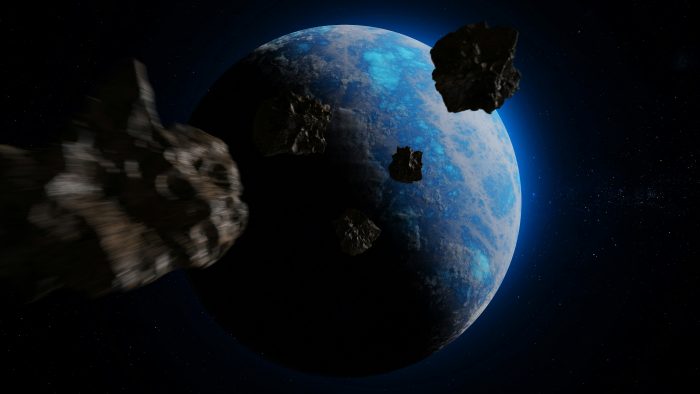
The Cretaceous Period and most of the creatures that define it met one of the most dramatic ends our planet has seen. While the exact nature of this event of mass destruction and extinction is up for debate, most evidence points to an asteroid impact causing the effects.
Asteroids are rocky bodies of leftover material from the solar system’s formation. They can be anywhere from a few to hundreds of metres in size and can be made of ice, clay, silicate materials or nickel-iron, depending on their type and how far from the sun they are formed. These ancient objects are some of the oldest things in our universe.
Other factors, including large-scale volcanic eruptions that caused drastic climate change to the dinosaur’s habitat and gradual changes to the Earth’s climate, have also been attributed to the end of the Cretaceous Period.
How big was the meteorite that killed the dinosaurs?
Once asteroids enter the Earth, any surviving fragments become known as meteorites. The widely accepted theory that a large asteroid caused the demise of the dinosaurs was only brought forward as recently as the late 1970s. American father-son duo Luis and Walter Alvarez led a research group that made a fascinating discovery.
Their research of rock samples from 65 million years ago found extraordinary levels of iridium, a rare element on Earth but prevalent in certain asteroids and comets. Further digging led to their hypothesis that the iridium-rich layer of dust was the aftermath of a large asteroid that vaporised upon impact with Earth.
The asteroid that caused this iridium dust to be so present in the atmosphere and is thought to have wiped out the dinosaurs is thought to have been between 10 and 15 kilometres wide. However, the force of its collision with the Earth created a monumental cavity. A 150-kilometre crater, the second largest on the planet.
Where did the meteorite that killed the dinosaurs hit?
This large dent in the Earth’s surface created by the deadly asteroid is known as the Chicxulub crater. Centred on the Yucatán Peninsula in Mexico, rocks from this site are where the Alvarezes and their team made their iridium-based discovery. Another decade would pass until definitive evidence of the site being an impact crater would come.
In 1978, geophysicist Glen Penfield was working to find locations for potential oil drilling in Mexico, and his findings led him to believe that the Chicxulub crater was indeed an impact crater. His employers initially rejected his theory, and Penfield wouldn’t receive his vindication until 1990.

A University of Arizona graduate student, Alan R. Hildebrand, was also investigating the crater. Hildebrand and Penfield would come into contact and begin further research with the help of a California-based team. Once enough evidence was available, the pair and others published their paper identifying the crater in 1991.
Penfield later said part of the reason to name the crater after the nearby town was to cause a pronunciation issue for those who rejected his findings in the past.
Did any dinosaurs survive?
A common misconception is that all dinosaurs were eliminated by the cataclysmic asteroid that hit Earth, but some lived on to tell the tale. All non-bird dinosaurs died, but some prehistoric sky dwellers lived on.
Why the event didn’t wipe out some birds is possibly due to their small size, ability to fly and varied diet. A lot of birds we see today are descended from the only surviving dinosaurs.
Dinosaur fossils at Fossils UK
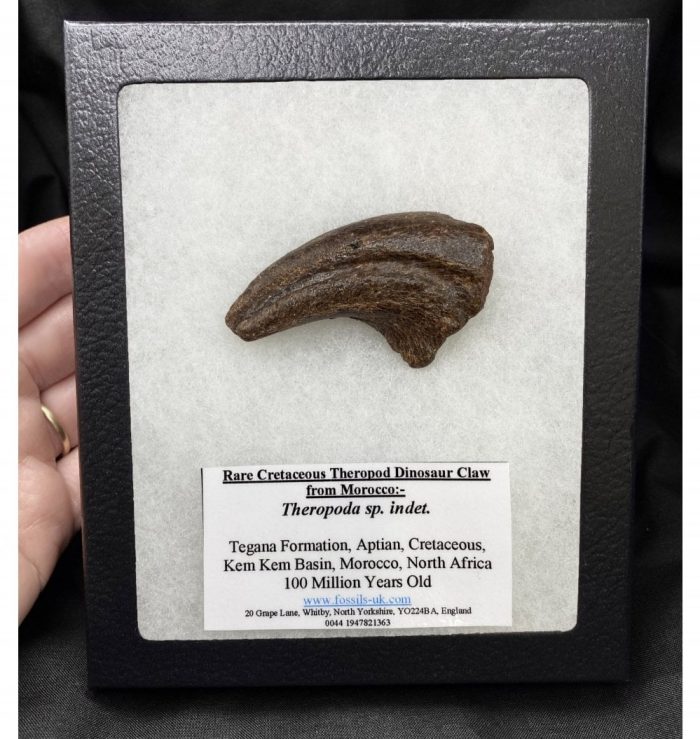
The legend of dinosaurs lives on to this day via valuable information passed down from generations of research, the museums that work to preserve it and, of course, fossils. Fossils are the biggest reason we know so much about the wondrous creatures that came before us.
At Fossils UK, we stock an incredible collection of dinosaur fossils. All of our fossils are ethically sourced and hand-selected from dig sites, finders, and collectors. Browse fascinating dinosaur teeth, claws and bones and find the perfect gift for a dino-obsessed loved one or treat yourself to a piece of natural history.
Comments are closed here.